On this page ⌄
The architecture
How reference components connect through the gateway to un-forked FHIR stores and analytics pipelines.
The end-to-end architecture
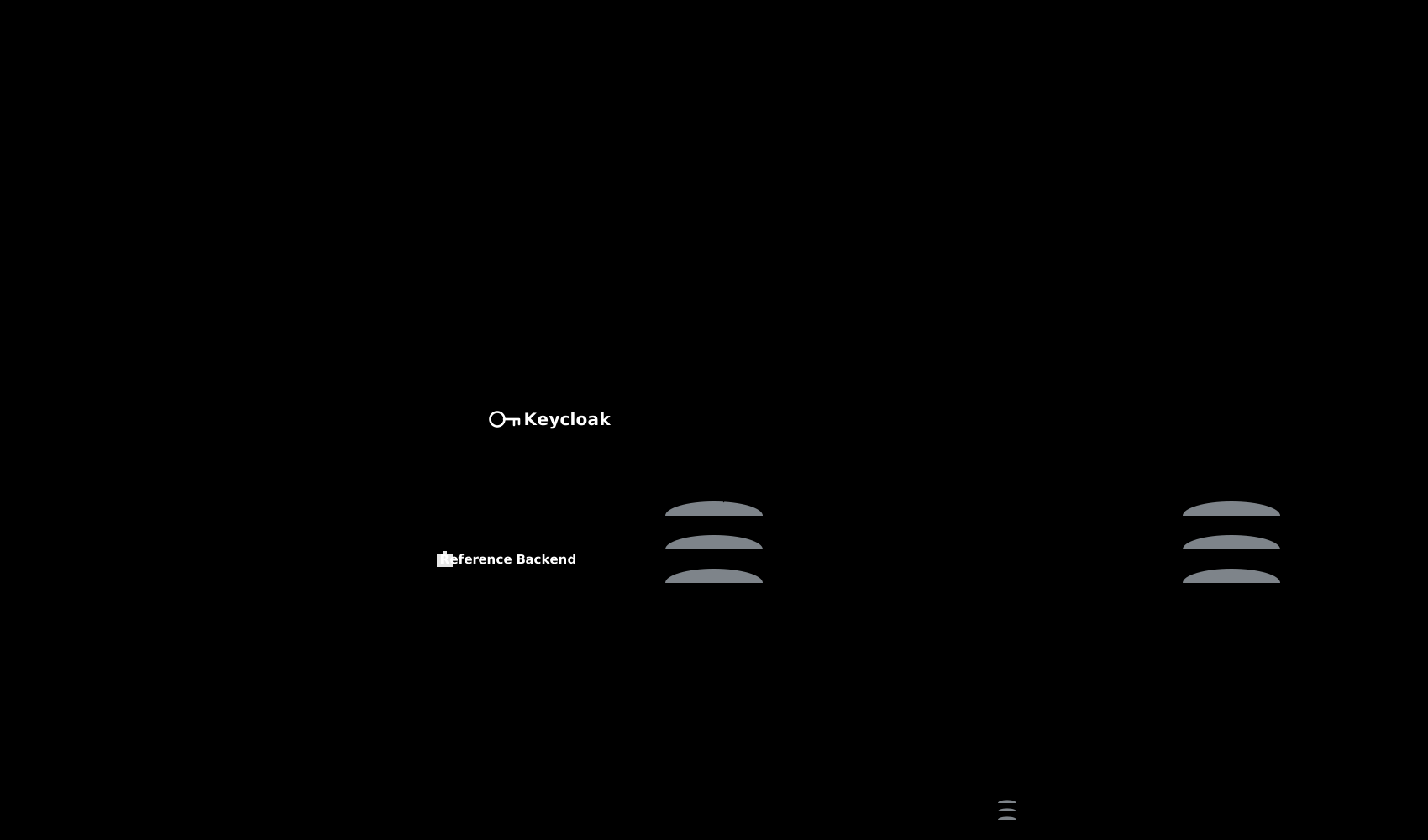
The diagram illustrates three primary layers within the reference environment.
- Client layer includes the multiplatform Frontline Client Application and the browser Web Admin Portal.
- Backend services include Info Gateway with custom extension plugins, Keycloak for identity, and an un-forked HAPI FHIR server.
- Analytics layer includes FHIR Data Pipes and PostgreSQL powering live Apache Superset dashboards.
Foundational building blocks
Open Health Stack provides unbundled open source building blocks that can be imported independently into any digital health project.

| Foundational component | Capability provided | Consumed by |
|---|---|---|
kotlin-fhir | Type-safe FHIR data models and JSON serialization | Client App |
kotlin-fhirpath | FHIRPath expression evaluation engine | Client App |
kotlin-fhir-engine | On-device SQLite persistence and sync | Client App |
kotlin-fhir-data-capture | Structured Data Capture (SDC) questionnaire rendering | Client App |
| Info Gateway | Authentication proxy and custom extension framework | Reference Backend |
| FHIR Data Pipes | SQL-on-FHIR extraction pipelines for analytics | Reference Analytics |
What the Player reference toolkit adds
| Reference component | What it adds |
|---|---|
| Player Client | Renders dynamic screens from declarative FHIR configuration |
| Configuration IG | Standard FHIR implementation guide defining screen layouts and views |
| Reference Backend | Custom gateway endpoints and role-based access rules |
| Reference Analytics | SQL-on-FHIR view definitions, queries, and Superset dashboard definitions |
| Reference Infrastructure | Turnkey Docker Compose topology linking all services |
Gateway routing and security
Neither client application connects directly to the underlying FHIR server. All network requests route through the Info Gateway reverse proxy.
- Un-forked FHIR store allows swapping HAPI FHIR for any standard FHIR server without altering client applications.
- Centralized access control validates OpenID Connect tokens from Keycloak and enforces role-based permissions at the gateway.
- Decoupled administration enables custom web portals to manage users, locations, and care teams purely through gateway APIs.
How data flows
- Frontline data entry occurs on mobile devices using Kotlin FHIR Engine for on-device SQLite storage and offline operation.
- Synchronization transmits FHIR resource bundles through the gateway to the central FHIR server upon network connectivity.
- Administrative management in the Web Admin Portal stores organisation, facility, and practitioner records directly as FHIR resources.
- Analytical transformation reads transactional FHIR resources and applies SQL-on-FHIR view definitions via FHIR Data Pipes, writing flattened relational tables into PostgreSQL.
- Reporting executes standard SQL queries against the analytical schema to populate dashboard metrics.
Where to go next
- The configuration model explains how screens and forms are configured with standard FHIR resources.
- Component directory provides technical summaries for each reference piece.